The decisive moments in soccer rarely happen at one speed. A player accelerates into space, brakes to receive under pressure, cuts away from a marker, and strikes through the ball within seconds. For serious athletes, kinesiology tape for soccer players can be a practical layer of muscle support and joint support within a well-tested preparation plan, without restricting the fluid movement the game demands.
Shop CannaTape Sport CBD Kinesiology Tape
Answer capsule: Soccer players use kinesiology tape as flexible training support around commonly loaded areas such as the ankle, lower leg, knee, thigh, and shoulder. The best approach is to select one clear purpose, apply the tape to clean and dry skin, test the placement during training, and reassess comfort before relying on it during a match.
Tape is not a shortcut around strength work, mobility practice, workload planning, or professional guidance. Its value comes from fitting cleanly into those systems. This guide explains how to make deliberate choices based on position, movement pattern, session demands, and the realities of a ninety-minute match.
Why kinesiology tape fits a soccer player's routine
Kinesiology tape offers flexible support that can move with the body through acceleration, deceleration, cutting, kicking, contact, and set pieces. Players get the most from it when the application has a specific purpose and has already been tested at realistic training intensity.
Soccer places repeated demands on the same movement chains. A fullback may sprint, recover, jockey, and cross in one sequence; a midfielder may rotate away from contact before opening the hips for a diagonal pass. Because the tape is flexible, a carefully selected placement can sit within this movement variety without the rigid feel of a brace.
The word carefully matters. More tape is not automatically better, and a complicated pattern is not automatically more useful. A serious player begins with the area that needs support, follows a clear application method, and evaluates how the setup feels in a warm-up before increasing intensity.
Support across changing speeds
Acceleration asks for a sharp first step, while deceleration asks the athlete to control momentum before the next action. Tape should remain comfortable through both phases. During a test session, include short sprints, controlled stops, lateral shuffles, curved runs, and a few changes of direction rather than judging an application while standing still.
Position-specific demands
A winger who repeatedly attacks the outside channel may prioritize a different area from a goalkeeper who dives, lands, and reaches overhead. Central players also absorb frequent contact while turning in tight spaces. The placement decision should reflect the player's actual movement profile, not a generic diagram copied immediately before kickoff.
A practical addition, not the entire plan
Kinesiology tape belongs beside a structured warm-up, suitable footwear, progressive training load, hydration, sleep, and active recovery. For a broader explanation of how flexible tape fits an athlete's routine, review this guide to kinesiology tape. Qualified sports professionals can also help players choose a suitable approach when an area needs individualized attention.
How should soccer players prepare tape for match day?
Prepare tape early enough to check adhesion and movement before the match begins. Clean and dry the skin, round the strip corners, apply without rushing, and complete a soccer-specific warm-up that challenges the intended placement.
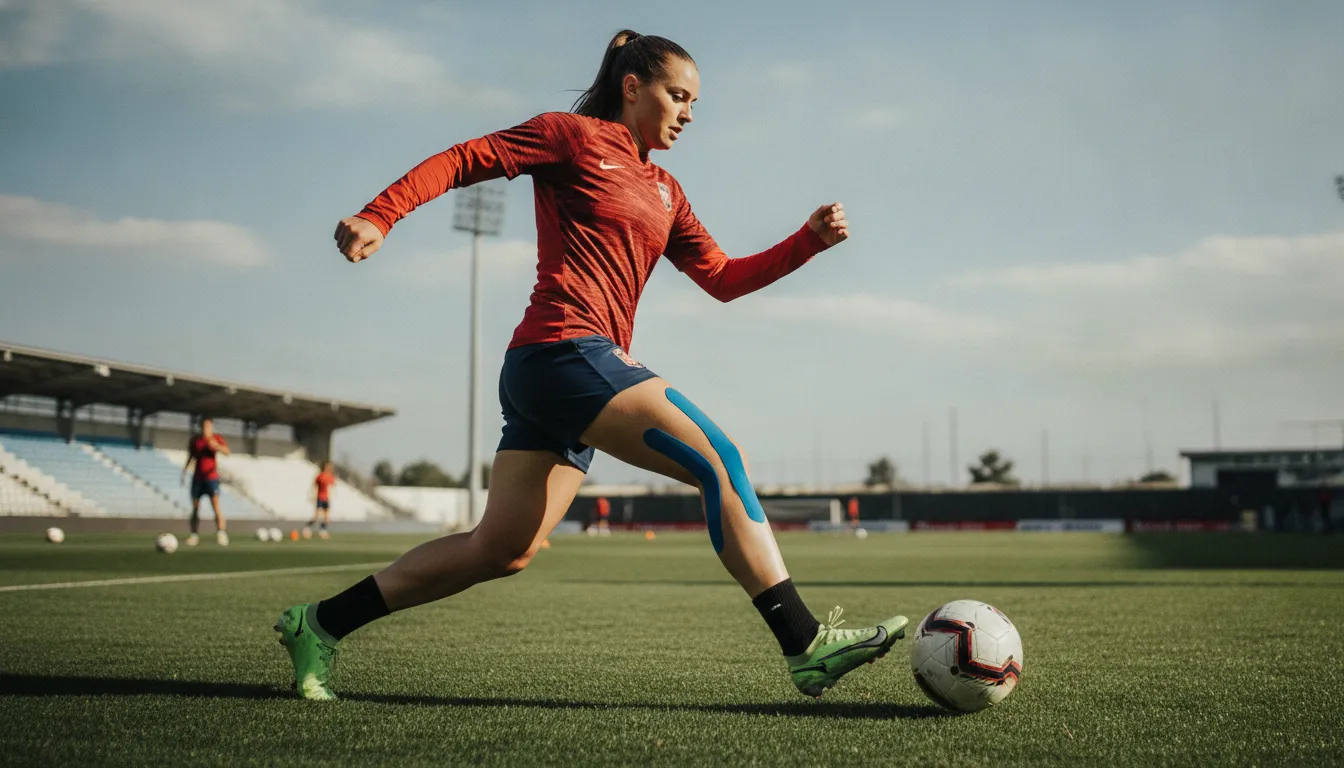
Match day is a poor time for experimentation. Test the same tape, placement, socks, shin guards, boots, base layers, and uniform during training. That rehearsal reveals whether an edge catches under a sock, whether a strip feels awkward during deep knee flexion, or whether contact with equipment changes comfort.
Start with clean, dry skin
Remove lotions, oils, and heavy residue from the intended area, then dry it fully. Sweat introduced during application can make consistent adhesion more difficult. If body hair makes application or removal uncomfortable, plan grooming well ahead of the session rather than making a last-minute change.
Build tape into the warm-up
After application, give the adhesive time to settle, then progress through the team's normal warm-up. Begin with easy movement before adding dynamic mobility, ball touches, passing, accelerations, braking, and position-specific actions. A striker should include a few controlled shooting movements; a defender should include backpedaling, jockeying, turning, and aerial preparation.
Check interaction with equipment
Soccer equipment creates friction and compression around common tape zones. Check the tape under match socks and shin guards, and make sure boot collars do not repeatedly rub an edge. Upper-body placements should also be evaluated under a fitted base layer and jersey during arm swing, shielding, and throw-in movements.
Use a simple match-day checklist
- Confirm the purpose and placement before leaving for the venue.
- Pack spare strips and small scissors in the kit bag.
- Apply to clean, fully dry skin with rounded corners.
- Run, cut, brake, kick, and turn during the warm-up.
- Remove or adjust the tape if comfort changes.
Common support zones for soccer training and matches
The ankle, lower leg, knee, hamstrings, quadriceps, and shoulder are common areas players consider for flexible support. Choose a zone based on the demands of the session and use an application pattern taught by a qualified source.
No single placement fits every player. Limb shape, playing position, prior experience, training volume, and equipment all influence comfort. The overview below is a decision aid, not an individualized application prescription.
| Support zone | Soccer demand to test | Useful evaluation moment |
|---|---|---|
| Ankle and foot | Cutting, landing, and changes of direction | Lateral movement and controlled set-piece approaches |
| Lower leg | Repeated running and striking the ball | Progressive sprinting and passing sequences |
| Knee | Braking, turning, and deep athletic positions | Deceleration drills and defensive jockeying |
| Hamstrings and quadriceps | Sprinting, kicking, and repeated transitions | Longer accelerations and controlled shooting |
| Shoulder and torso | Contact, arm drive, reaching, and throw-ins | Shielding drills and full throw-in motion |
Ankle and foot support
The ankle works through rapid angle changes as a player plants, cuts, receives contact, and adjusts to the ball. Tape applications in this area must be checked inside the boot and beneath the sock. Players seeking more detail can review CannaTape Sport's ankle-focused guide before discussing placement with a qualified sports professional.
Lower leg and knee support
The lower leg and knee manage repeated running, braking, and turning across a session. When testing these placements, include actions that reproduce the actual game rather than only straight-line jogging. A player should be able to move confidently into low defensive positions and transition out without distracting pull at the tape edges.
Hamstrings and quadriceps support
The thigh contributes heavily to acceleration, top-speed running, and striking through the ball. A tape setup should feel comfortable as the hip extends during sprinting and as the knee moves through a full kicking action. Progressive shooting practice is more informative than taking one maximal strike immediately after application.
Shoulder and torso support
Upper-body demands are easy to overlook in soccer. Players use the shoulders and torso while shielding possession, contesting aerial balls, reaching during balance corrections, and taking throw-ins. Any placement should be tested under the match jersey and through full arm movement.
How to test tape during training before a match
A reliable tape routine is built during training, where players can evaluate placement under realistic speed and fatigue. Use a progressive test that moves from basic mobility to soccer-specific actions, then note comfort during and after the session.
Begin with a lower-stakes session rather than a decisive fixture. The objective is not to prove the tape can survive every possible demand at once. It is to learn whether the chosen placement remains secure, comfortable, and unobtrusive as movement complexity increases.
Phase one: movement and ball contact
Start with easy jogging, mobility work, and controlled changes of direction. Add short passing, first touches, and gentle striking so the body moves through familiar soccer patterns. If the tape bunches, catches, or becomes distracting, stop and reassess before moving faster.
Phase two: speed and deceleration
Progress to short accelerations, curved runs, controlled stops, and lateral cuts. These actions reveal more than steady running because they challenge the application through rapid changes in force and body angle. Keep the first repetitions controlled, then build toward the intensity expected in the upcoming session.
Phase three: position-specific work
Complete actions that mirror the player's role. A winger can combine an overlap with a cross, a central midfielder can receive on the turn before switching play, and a center back can backpedal before contesting an aerial ball. Goalkeepers should test footwork, set positions, reaching, diving technique, and distribution.
Record what worked
A simple note on strip length, placement, timing, equipment interaction, and session response makes the next application more consistent. Photographing a comfortable setup can also help, provided the image is used only as a personal reference. Review the setup with a qualified professional when individual guidance is needed.
Will kinesiology tape stay on through sweat and long sessions?
Quality kinesiology tape is designed for active use, but adhesion depends on skin preparation, placement, equipment friction, and exposure to sweat. CannaTape Sport tape uses sweat-resistant, hypoallergenic, latex-free adhesive and may be worn for up to five days when it remains comfortable and secure.
A full soccer day can include travel, activation, a long warm-up, match minutes, stoppage time, and a cool-down. Adhesion should therefore be evaluated as part of the complete day, not only during kickoff. Players should inspect edges after periods of heavy sweat and after changing clothing.
Improve adhesion without overcomplicating it
Apply tape to clean, dry skin and avoid touching the adhesive more than necessary. Round each corner so sharp points are less likely to catch under socks or clothing. Smooth the strip after placement and allow time before the warm-up begins.
Manage socks, shin guards, and boots
Edges placed directly beneath firm equipment may experience repeated rubbing. During training, reproduce the same equipment setup planned for the match and inspect the tape afterward. A secure application should not require constant adjustment or draw attention away from play.
Know when to remove it
Remove tape if it becomes uncomfortable, causes visible skin concern, rolls significantly, or no longer feels secure. Do not force an application to remain merely because the label allows multi-day wear. Personal comfort and skin response determine whether continued wear makes sense.
Add CannaTape Sport CBD Kinesiology Tape to Your Kit
How does tape fit into a post-match recovery routine?
After the final whistle, inspect the tape, equipment contact points, and skin before deciding whether to keep or remove the application. Pair that check with hydration, nutrition, sleep, easy movement, and the player's established post-match recovery routine.
The match may be finished, but useful evaluation continues. Note whether the tape stayed comfortable during late-game fatigue, repeated set pieces, contact, and the cool-down. Those observations can guide the next training application more effectively than memory alone.
Complete a calm post-match check
Once breathing and body temperature begin to settle, inspect the full application in good light. Look for lifted edges, bunching, unusual marks, or areas affected by socks, guards, boots, and clothing. If everything remains comfortable, follow the product directions and personal plan for continued wear.
Remove tape slowly
When removal is appropriate, take time rather than pulling quickly. Support the skin and peel the tape back gradually, following product guidance. A shower or suitable oil may make removal more comfortable, but the area should be cleaned and dried before any later application.
Connect observations to training load
Tape is one detail within a much larger recovery picture. Consider match minutes, high-speed efforts, contact, travel, sleep, and the next scheduled session when planning active recovery. For more routine-building ideas, see this kinesiology tape recovery guide.
What makes CBD kinesiology tape different?
CBD kinesiology tape combines flexible athletic tape with hemp-derived CBD in the same strip. CannaTape Sport tape contains 10mg of hemp-derived CBD per strip and uses a sweat-resistant, hypoallergenic, latex-free adhesive for active routines.
The practical soccer standard remains the same: select the placement deliberately, test it during training, and evaluate comfort throughout wear. The CBD component does not replace good application, progressive preparation, or professional guidance. It is a product distinction for athletes who want that format within their established routine.
Built for an active schedule
A soccer player's week may include field training, gym work, tactical sessions, travel, and a match. Tape that may be worn for up to five days can fit a multi-day schedule when it stays secure and comfortable. Players should still inspect the application regularly and remove it when continued wear no longer makes sense.
Product details serious athletes should verify
Before selecting any tape, review its adhesive, material, wear guidance, and application directions. CannaTape Sport identifies its adhesive as hypoallergenic and latex-free, and its tape as sweat-resistant. Athletes can also review independent perspectives from Hospital for Special Surgery, the Cleveland Clinic, and a peer-reviewed overview when considering kinesiology tape as a support tool.
Keep expectations grounded
No tape application guarantees a better sprint, cleaner strike, or stronger performance. Its role is support within preparation and recovery routines. Serious players should evaluate it by clear standards: comfort, secure placement, compatibility with equipment, and ease of movement during soccer-specific actions.
A position-by-position match-day framework
Different roles expose players to different movement patterns, so tape testing should reflect position-specific demands. Build the final check around the actions most likely to decide the player's match.
Forwards and wingers
Attackers repeatedly accelerate, brake, cut across defenders, and strike from changing body positions. Their warm-up test should include curved runs, quick changes of direction, first-time finishes, and crosses. Tape should remain unobtrusive as stride length and kicking intensity rise.
Midfielders
Midfield play combines repeated scanning, turning under pressure, contact, and transitions in both directions. Test applications through tight-space receiving drills, lateral movement, pressing actions, and longer passing. The setup should feel consistent in both upright running and lower athletic positions.
Defenders
Defenders backpedal, jockey, pivot, sprint toward their own goal, and contest set pieces. Their preparation should reproduce those patterns, including controlled aerial work and landing. Equipment contact matters especially when tape sits beneath long socks or close to shin guards.
Goalkeepers
Goalkeepers require explosive footwork as well as reaching, landing, and distribution. A useful test progresses from set positions and short movements into controlled dives, catches, throws, and kicks. Upper-body tape must also remain comfortable beneath the goalkeeper jersey through full reach.
Frequently Asked Questions
These concise answers cover the most common questions soccer players ask when adding kinesiology tape to training, match-day preparation, and active recovery.
What is the purpose of kinesiology tape for soccer players?
Kinesiology tape for soccer players is a flexible support tool used around selected muscles and joints during training, match-day preparation, and active recovery. It should complement strength work, mobility, workload planning, and professional guidance rather than replace them.
Is kinesiology tape a substitute for professional guidance?
No. Kinesiology tape is not a substitute for individualized guidance from a qualified sports professional. Players should seek expert input when they are unsure about placement, application, or whether tape suits their circumstances.
How long can you wear kinesiology tape during a soccer match?
CannaTape Sport kinesiology tape may be worn for up to five days when it remains secure and comfortable, which includes the duration of a soccer match. Players should inspect it regularly and remove it if comfort changes, the skin shows concern, or the tape no longer adheres securely.
How is turf tape different from standard kinesiology tape?
Turf tape is generally used as a barrier against friction during contact with artificial turf, while kinesiology tape is flexible athletic tape used for muscle support and joint support. Players should choose the product that matches their intended purpose and follow its specific directions.
Ready to build a smarter soccer tape routine?
Choose a clear support goal, rehearse the application during training, and make the final decision based on comfort during acceleration, deceleration, cutting, kicking, and contact. A disciplined process turns tape from a last-minute accessory into a considered part of match-day preparation.
Keep the routine simple enough to repeat. Record successful placements, pack spare strips, and continue to prioritize warm-ups, training load, equipment, sleep, and active recovery. Players interested in lower-leg applications can also review this lower-leg taping guide.